
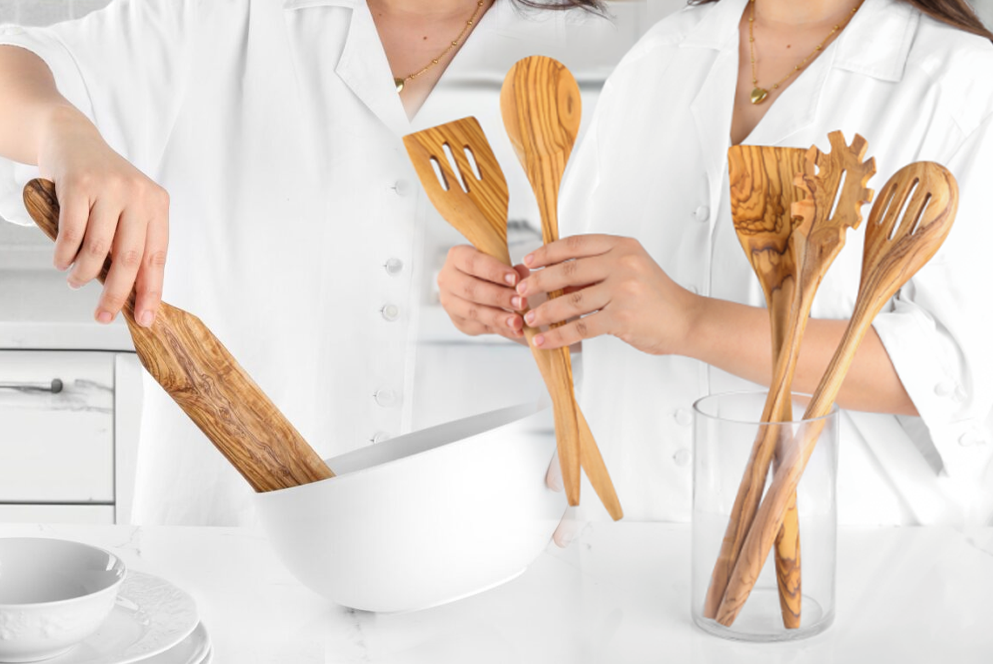
Olive wood spoons, spatulas and serving tools combine useful shapes with distinctive natural grain. Here are seven practical reasons to consider them, plus the details to compare before choosing a utensil.
1. Each piece has individual grain
Olive wood ranges from lighter golden tones to darker brown markings. The pattern varies between pieces, so the spoon you receive has its own appearance.
2. Different shapes suit different tasks
A flat spatula, a curved spoon and a slotted server do different jobs. Choose a head shape for the way you cook rather than selecting only by appearance.
3. Slotted utensils help drain liquid
Slots let excess liquid drain when lifting food. Compare a slotted spoon for vegetables with a slotted spatula for turning and serving.
4. Corner designs help reach around a pan
Corner spoons and curved spatulas are shaped for stirring and scraping around the contours of pots and pans. Check the utensil dimensions and your cookware manufacturer's care guidance.
5. Serving pieces work at the table
Salad forks, spoons and sporks can move from kitchen preparation to shared dishes. Compare individual utensils and sets to see exactly what is included.
6. Handmade details make useful gifts
An individual spoon, a serving pair or a utensil holder can be a practical gift for someone who enjoys cooking. Personalisation is available only where stated on the selected product page.
7. Care is straightforward when matched to the product
Follow the item's care instructions. Our wooden kitchen utensils generally call for hand washing with mild soap, prompt drying and occasional oiling. Avoid soaking and dishwashers where specified.
Choose your next kitchen tool
Explore olive wood spoons and spatulas, then browse utensil holders and kitchen gadgets for complementary pieces. Read each product's size and care details before ordering.